
NDIS Overview
The National Disability Insurance Scheme (NDIS) can feel complex and overwhelming, with lots of new terms, processes, and decisions to navigate—especially when you’re supporting a child with disability. We’ve created this online resource to help parents understand the basics of the NDIS, how it works, and what it may mean for your family. It’s designed as a clear, practical starting point, giving you simple explanations and helpful guidance so you can feel more confident and informed as you explore NDIS supports for your child.
What is the NDIS?
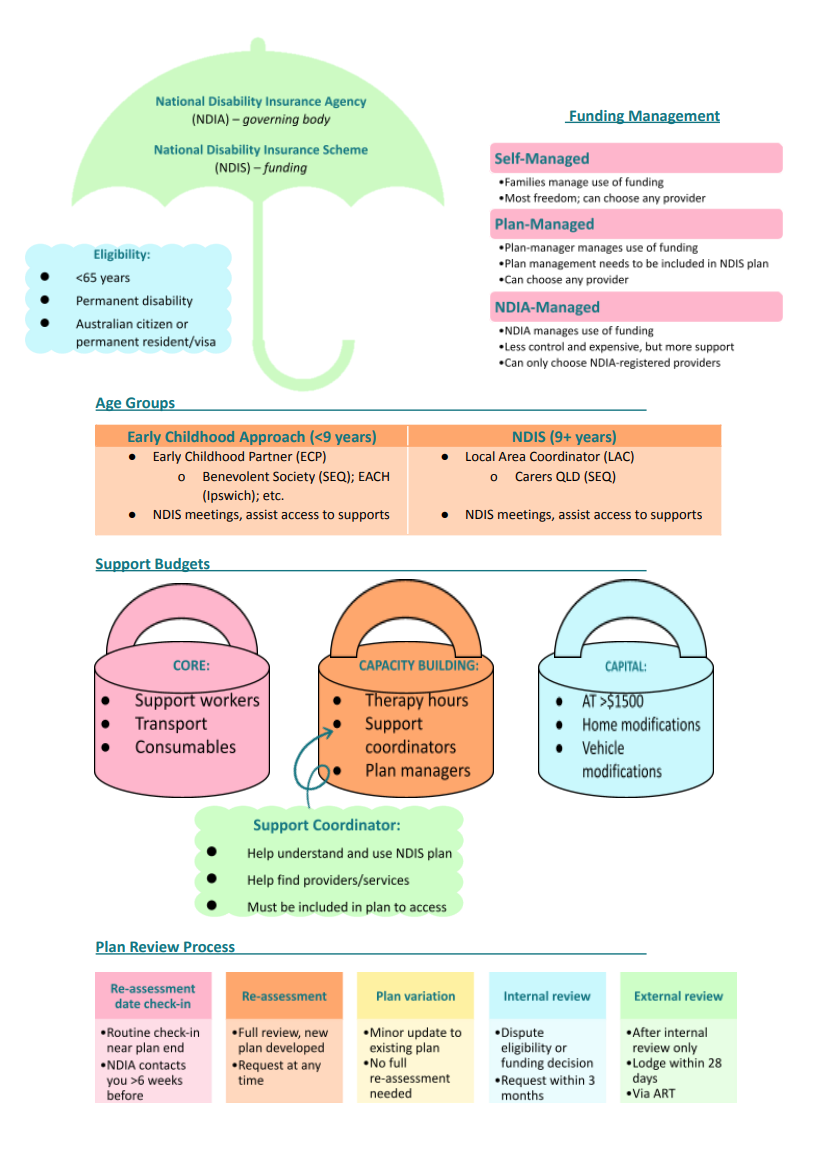
NDIS = National Disability Insurance Scheme
An Australian government program that funds supports for people with disabilities or developmental delays. It began rolling out in Queensland in 2016.
It funds items, services, and supports that are reasonable and necessary and linked to a participant’s disability or developmental delay.
Eligibility criteria:
Age <65 years
Australian citizen, permanent resident, or permanent visa holder
Must have a permanent disability that significantly affects daily life and functional capacity — or meet early intervention requirements.
What is the NDIA?
The NDIA = National Disability Insurance Agency
The Commonwealth body that runs the NDIS.
It NDIA decides who can access the scheme and what supports can be funded.
Sometimes you will deal directly with the NDIA and other times you may deal with an NDIA partner (people who the NDIA contract to help them with certain areas of the NDIS).
Funding for Different Age Groups
<9 years = Early Childhood Approach (ECA)
This funding is classed under the Early Childhood Approach. Your child will still have NDIS funding, however it will often be referred to as ECA or sometimes Early Intervention (EI) funding.
Children under 6 can access support even without a diagnosis. Children 6–8 with a permanent disability are also covered under ECA.
9 years – 64 years = NDIS
For children and adults 9 years and older, this is referred to as NDIS funding.
Key People who can help
Early Childhood Partner (ECP) - for ECA participants (<9 years)
In Greater Brisbane: Benevolent Society
In Ipswich: EACH
Conducts plan meetings, guides you to supports, and connects you with community services.
Local Area Coordinator (LAC) - for NDIS participants (9+ years)
In South-East Queensland: Carers Queensland
Helps you apply, create, implement and review your NDIS plan, and connect with community supports.
Support Coordinator - optional add-on
Helps you understand and use your plan, find providers, and build your confidence in managing supports.
Must be included in your plan to access.
Plan Manager - optional add-on
Manages your funding and pays invoices on your behalf.
Funded on top of your plan budget — it doesn't reduce your therapy or support dollars.
Must be included in your plan.
Support Budgets
For all participants, NDIS funding is split into 3 categories: core support, capacity building support and capital support budgets.
Your plan will show a total budget amount across these categories, making it easier to track overall funding.
Core Supports
Everyday activities and disability-related needs — support workers, transport, consumables (e.g. continence products), and low-cost assistive technology. Most flexible budget.
Capacity Building Supports
Building skills and independence — therapy hours (physio, OT, speech pathology, exercise physiology), support coordination, and plan management fees.
Capital Supports
Higher-cost, one-off items — complex assistive technology, home modifications, and vehicle modifications.
Types of funding management
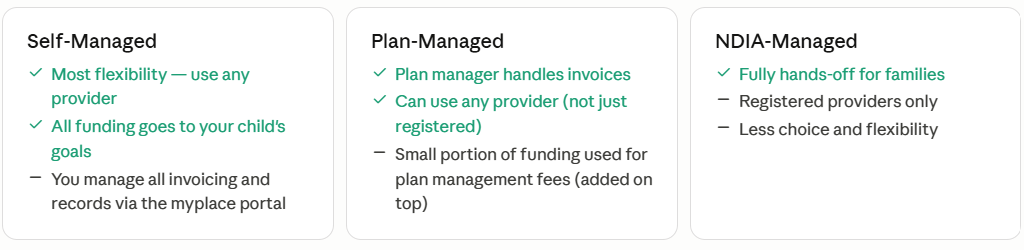
There are 3 ways of managing funding in an individual’s NDIS plan: self-managed, plan-managed or NDIA-managed. Individuals can choose a combination of management options across different areas of supports.
Assistive Technologies / Equipment
AT includes any equipment or device that helps your child do things more easily or safely because of their disability. The NDIA looks at two things when deciding what evidence and process is needed: the item's cost, and its risk level.
1. Product Cost
Low-cost AT (<$1,500 per item): no support letter needed. Funded from Core Supports (consumables).
Mid-cost AT ($1,500–$15,000 per item): requires a support letter from a relevant health professional (approx. 1.5–3 hrs to prepare).
High-cost AT (>$15,000 per item): requires a formal assessment, quote, and report. Practitioner time approx. 3–6 hrs.
2. Product Risk
Low-risk AT: unlikely to cause harm. Easy to set up and use without professional advice. Can often be trialled or purchased in retail stores. Examples: resistance bands and therapy putty, non-slip mats, basic walking frames or crutches.
Higher-risk AT: complex, potentially harmful, or requires professional setup, training, or advice for safe use. Examples: custom AFOs and splints, manual or power wheelchairs, standing frames, and gait trainers.
Cost and risk don't always align — a prefabricated AFO might be low cost but still higher risk if it needs careful fitting by a physio or orthotist. For higher-risk AT, the NDIA requires advice from a qualified AT advisor before purchase, regardless of cost.
NDIS Support Lists
The NDIA has published a formal list of what NDIS funding can and cannot be spent on. There is now a clear "yes" list, a "no" list, and a separate replacement list for certain substitutions (see below). The goal is to remove the grey areas that previously caused confusion for families and providers.
For most families using therapy and everyday disability supports, very little will change — the vast majority of what children currently access remains fully funded. Where it matters most is if you're unsure about a specific item or if your child's therapist recommends something that isn't obviously on the approved list.
If you're ever unsure whether something can be funded, ask your therapist, plan manager, or LAC before purchasing. Since October 2025, the NDIA can raise a debt for purchases on the "no" list regardless of cost.
Replacement Supports
Alongside the support lists, a new process allows families to apply for a "replacement support" — an item that isn't normally funded by the NDIS, but that could genuinely work better for your child than the standard alternative. A common example is a tablet or smartwatch used for communication or daily living skills.
To apply, you tell the NDIA what the item is, what it would replace, how much it costs, and why it would better meet your child's needs. No formal report or assessment is required, but you do need written approval from the NDIA before purchasing — and only one replacement support can be requested per plan period.
Your therapist or support coordinator can help you build the case for a replacement support if they believe an alternative item would give your child better outcomes.
NDIS Review Process
The NDIA is introducing a new way of building NDIS plans. Rather than focusing primarily on your child's functional impairments, the new approach centres on their overall support needs — what they need help with day-to-day, and what supports will make the most difference to their life.
As part of this, an assessor will work with your family to understand your child's needs before a plan is developed. This replaces the previous approach where families often needed to gather their own medical reports and evidence. The aim is a more consistent, less burdensome process.
This is being rolled out gradually from mid-2026. Most families won't experience any change until their next plan review. Your ECP or LAC will guide you through the new process when the time comes.
Types of NDIS Reviews
What each type means, who can ask for it, and what to expect.
| Type | Who initiates | What it is | Outcome | Timeframe |
|---|---|---|---|---|
|
Plan reassessment date check-in
Previously: scheduled plan review / end-date review
|
Scheduled | A routine check-in as your plan approaches its reassessment date. The NDIA contacts you to discuss whether your current plan is working and whether anything needs to change. | Plan continues as-is, is varied, or a full reassessment is triggered | NDIA contacts you at least 6 weeks before the reassessment date. If no new plan is approved in time, your current plan auto-extends for up to 12 months. |
|
Plan reassessment
Previously: plan review / change of circumstances review / unscheduled review / s48 review
|
You or NDIA | A comprehensive look at your plan. A new plan is developed to reflect your child's current needs, goals, and circumstances. Can be requested at any time — you don't have to wait for the reassessment date. | A new plan is approved (same supports, minor changes, or significantly different) | NDIA responds within 21 days to confirm whether they'll proceed with a reassessment |
|
Plan variation
Previously: light touch review / minor plan change
|
You or NDIA | A minor adjustment to your existing plan without doing a full reassessment. Used for smaller changes: adding a specific item of AT, adjusting funding structures, changing management type, or responding to a short-term crisis or emergency need. | Current plan is updated; reassessment date stays the same | NDIA responds within 21 days of receiving your request and supporting evidence |
|
Internal review of a decision
Previously: s100 review / review of reviewable decision
|
You | A formal request to have an NDIA decision reconsidered — for example, if your child was found ineligible, or if you believe your plan is underfunded. A different NDIA officer reviews the original decision fresh. | Decision confirmed, varied, or set aside and remade | Must be requested within 3 months of the original decision. NDIA aims to respond within 28 days. |
|
External review (ART)
Previously: AAT appeal. Now: Administrative Review Tribunal — independent body since October 2024
|
You (via ART) | An independent review by the Administrative Review Tribunal (ART), entirely separate from the NDIA. Can only be requested after an internal review is completed. No application fee. Legal representation is optional. | ART may confirm, vary, or set aside the NDIA's decision. Your current plan stays active throughout. | Must be lodged within 28 days of receiving the internal review decision |
Summary
Quick Glossary
Participant: The person eligible for NDIS support.
NDIS Plan: A written agreement outlining a participant’s goals, needs, and funded supports.
Provider: Someone who delivers products or services to help participants achieve their goals (e.g., therapist).
Supports: Assistance that helps a participant with daily activities and achieving goals.
Formal Supports: Paid supports with an agreement or contract.
Informal Supports: Unpaid support from family or friends.
Mainstream Services: Government services for the general public, outside of the NDIS (health, education, mental health, justice, housing).
Nominee: A person (usually a family member) chosen to help manage supports on the participant's behalf.
Consumables: Everyday items required because of a participant's disability.
Reasonable and Necessary: The standard NDIS uses to decide if a support should be funded. NDIS-funded supports must:
Be related to the participant’s disability
Represent value for money
Be effective and beneficial
Consider informal supports available
Be funded by the NDIS